The curse of back pain
Your thirties arrive, and with them their little health worries... Fatigue, back pain... What if their cause were not vague concepts like “age”, “stress” or “a sedentary lifestyle”, but a very discreet parasite?

to Silvère and Quentin
By way of introduction
“They were funny, all the same, our ancestors! They believed in gods to explain nature and its physical phenomena, before science gave them better explanations!”
“Yes, except that we haven't yet left that mentality behind…”
“What do you mean? Now that science explains the world, there's no need to invent gods!”
“The gods of the Ancients mainly represented the forces at work in the Universe: the Sun, lightning, the forest… Personified, they came alive.”
“So?”
“Well, what do we do today? When we say ‘It's age’, ‘It's genetics’, ‘It's normal’, aren't we sometimes confessing our ignorance? Don't we attribute certain diseases to concepts that the general public poorly understands and which, very often, do not on their own explain the diseases in question?”
“What do you mean?! It is firmly established that genetics causes certain diseases!”
“That it predisposes to them, for a start. And secondly: what causes these genetic mutations?”
“Well, the normal functioning of the cell, time, age too, sometimes…”
“Which gives us three more gods: Time, Age, and Genetics…”
Dear readers,
Let us turn to this colourful question of back pain, sciatica and lower back pain which, without warning, wreak havoc on the daily lives of thousands of our contemporaries.
They often appear for the first time between the ages of 35 and 40, can recur, or even stay with their victim until death.
First correlation
Back pain appears relatively rarely in childhood, but far more often at a “mature” age. The doxa simply concludes: back pain is supposedly a curse that strikes thirty-somethings unawares, a fatality engendered by the god Time, and triggered by a whim of the god Age.
But that explanation frustrates the curiosity that drives me…
Why the “age” factor is not satisfactory
When people talk to me about “Time” or “Age”, I remain sceptical.
Time is a quantity, not a quality. Age comes closer to a quality… But you find people in better health at 80 than at 50, and some 60-year-old “young bucks” would put asthenic 30-year-old “old-timers” to shame!
The “Age + Time” interpretation therefore seems simplistic.
So I decide to follow my favourite lead, armed with my Parazor.
Some surprising results
First Chinese study [1], first finding.
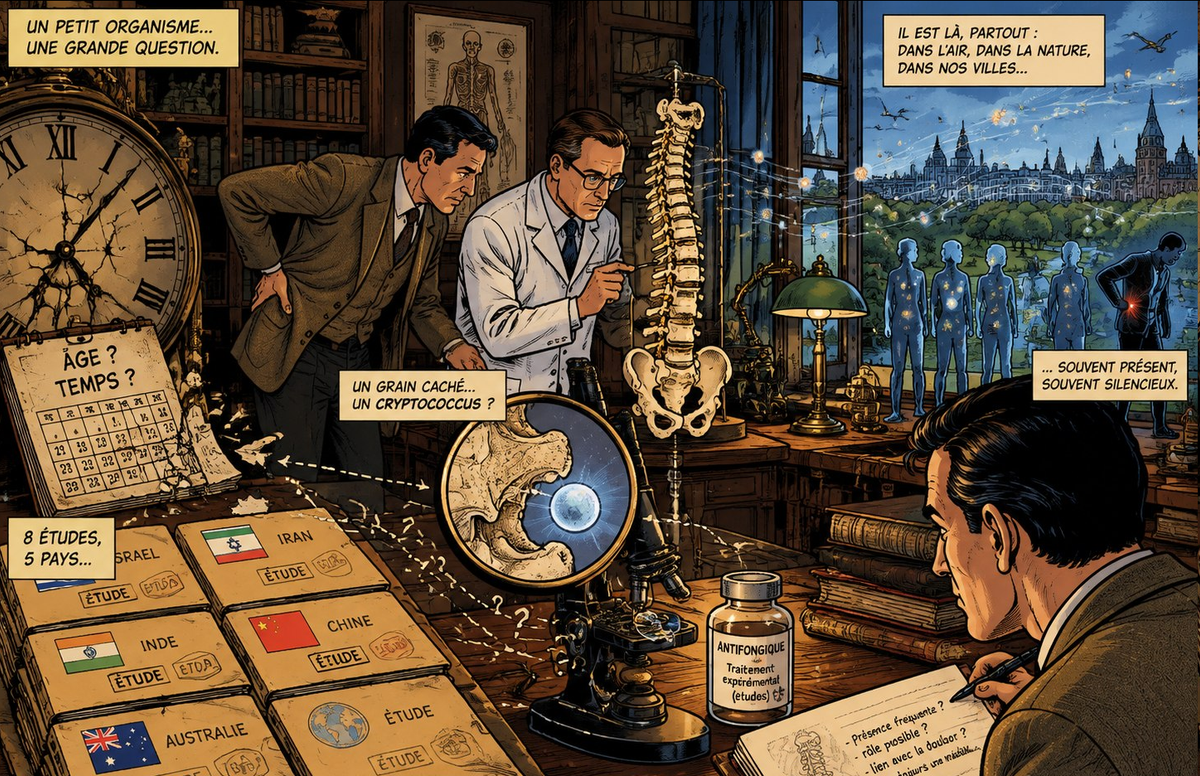
Among the potential culprits behind thirty-somethings' back pain, we discover a little nothing of a fungus: a Cryptococcus neoformans (bless you)!
Crypto-, for “hidden”, and coccus, for “grain”, as in Streptococcus. A round microbe, master of hide-and-seek.
Cryptococcus, the return
But despite its talents as a discreet swindler, our hidden grain gets itself noticed once again.
A second study, also Chinese [2], reports its detection in an odd case: at first, the patient suffered from back pain, and local tuberculosis was suspected.
But no, it was our “friend” Cryptococcus that was behind the pain.
It used to be thought that it only attacked when disseminated throughout the body: we learn from this study that it can attack the vertebrae without being spread everywhere…
Here too, an antifungal treatment manages to stem the pain. Farewell, Crypto?
Things come in threes
A third study, Israeli [3], finding Cryptococcus in a “healthy” female patient, reports in turn:
“Since this case, as well as most of the cases of cryptococcal myelitis previously described, were in normal hosts, cryptococcal myelitis should be considered in the differential diagnosis even in a normal host, and therefore, before any invasive diagnostic procedures, the cryptococcal antigen in serum should be determined” (emphasis ours).
In other words, and this is a result worth remembering, immunocompetence (the absence of clinical signs, the “asymptomatic” side) does not immunise against Cryptococcus. On the contrary, this fungus may very well be inside us for years lying low, before ending up becoming painful…!
Indeed, I then found 5 other studies pointing in the same direction:
[4] A fungus was suspected, but not the right one: the back pain was linked to Cryptococcus…
[5] Another “immunocompetent” patient, with back pain and other systemic symptoms, who would end up dying because of… Cryptococcus. “First case of disseminated cryptococcosis in an immunocompetent patient with back pain” (Iranian study).
[6] Finally a “Western” study, an Australian one: a 53-year-old local man who had been “diagnosed” with ankylosing spondylitis (well, well, well, we talk about that here)… And in the end, it was a Cryptococcus!
[7] Hong Kong, a 27-year-old woman suffering from back pain… Which is in reality a “localised infection of the lumbar vertebrae and paravertebral muscles”. Which, in 1989, was a rare reality… All the more “rare” since a biopsy would be needed to identify our very own Crypto…!
[8] Case of an immunovulnerable patient, suffering from scleroderma and rheumatoid arthritis. But “first case of primary cryptococcosis of the lumbar vertebrae”. The study is from 2013, it seems to duplicate its upstairs neighbour from 1989, but let's grant it…
Eight studies, then, in five different countries, converging on the same lead: Cryptococcus could be responsible for some back pain!
And across all these cases, there are enough “immunocompetent” patients, which means that one can be, by the usual clinical criteria, in “full health”, but host a Cryptococcus and the back pain that goes with it.
Crypto: the huge stakes
All this would be anecdotal, insignificant, even ridiculous, were it not for one tiny little detail. As modest and overlooked as our hidden grain…
Cryptococcus is, literally, ubiquitous. It is found in soils, in wood, in pigeon droppings (greetings to our Parisian readers!). Its spores are present “in the towns and in the countryside”, as the saying goes.
So much so that this silent squatter is called a “commensal”.
Now, a “commensal” is, literally, a “table companion”.
Except that this expression does not reflect the damage the fellow does: would I want to invite such a troublemaker to my table? Obviously not, but I had no choice! He claimed the right to come and freeload, and pulls off the feat of growing at a landlord's place without paying any rent.
Cryptococcus neoformans fits the definition not of a commensal, but of a parasite!
But it gets nine times worse
The most troubling aspect of this parasite is probably its stealth.
I'll come back to it in a forthcoming article.
More after the break!